Too Close for Comfort: the Somerville Plot
Phil Watson
Monday 16 November, 6.00 pm - White Swan
In October 1583, John Somerville, a Catholic from Warwickshire, declared his intention to travel to London and shoot Queen Elizabeth I. He was quickly arrested and sent to the Tower along with some of his family.
This, and what happened next, sent a seismic wave of terror and uncertainty across Warwickshire and the surrounding counties.
Was the law being exerted at its most deadly or was there a deeper, more sinister force at work behind the scenes?
Phil Watson delivers a wide range of historical talks. He is also known as 'Mr. Shakespeare' at certain celebratory times!
Phil also works for the Shakespeare Birthplace Trust, although in this talk he is not speaking as their representative.
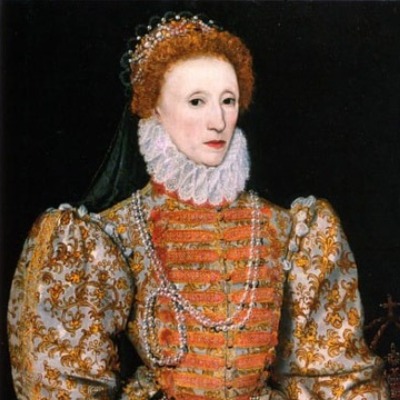
Image courtesy of WikiImages via Pixabay. Darnley Portrait of Queen Elizabeth I, c1575
Report of the Talk
There were three 'terrorist' plots in the Stratford area, but only two of them were genuine: assassination plots against Queen Elizabeth to replace her with Mary, Queen of Scots, involved Francis Throckmorton (1583) and Anthony Babington (1586). The Stratford connection involved Robert Dudley, Sir Ambrose Dudley, Edward Arden and John Shakespeare.
The heightened religious 'temperature' in those times dated from Henry VIII’s break with the Roman Catholic church, Edward VI’s Act of Uniformity in 1558 and the spread of Protestantism, with the Book of Common Prayer. King Edward VI’s schools were funded by the Dissolution of the Monasteries. Henry VIII and Elizabeth were ambiguous about religious beliefs and actual practice.
The first Warwickshire connection involved Sir John Dudley, Duke of Northumberland, later Earl of Warwick.He was involved in the brutal suppression of Kett’s Rebellion against enclosures in 1549, and his sons, Ambrose and Robert Dudley were also involved. He and Edward, Duke of Somerset were rivals for control of the young Edward VI, and Somerset was executed due to Dudley, who in turn was executed for his part in the attempt to enthrone Lady Jane Grey after the King’s death.
Second, John Dudley’s first son, Sir Ambrose Dudley, Earl of Warwick, was the landlord of Richard Hathaway, and John Shakespeare was also one of his tenants. His second son, Sir Robert Dudley, Earl of Leicester, was commander of Queen Elizabeth’s forces, based at Kenilworth Castle. He was a fervent Protestant.
This family wanted to keep its 'mediaeval' hierarchy (descended from Guy de Beauchamp) and it claimed Saxon lineage. It also claimed to be descended from Guy of Warwick, a legendary, even mythical, crusader, who later repented and became a hermit in disguise in Guy’s Cliffe in Warwick. However, he was seven feet tall so not hard to recognise!
The third Warwickshire connection was Edward Arden, a cousin of Mary Arden, Shakespeare’s mother. He was a Catholic, based in Castle Bromwich, and he was well regarded. He was also the uncle of Robert Catesby (of Gunpowder Plot fame). Edward was married to Mary Throckmorton. He was known as a 'protector' of a priest, which was held against him. However, Queen Elizabeth was initially quite relaxed about 'private' Catholics, and recusants like him paid fines. William Underhill, of New Place, was another. He sold the property to William Shakespeare when he could no longer afford to pay for its repairs, due to keeping a priest, otherwise known as the gardener!
Then there was John Shakespeare, who knew William Catesby, father of Robert. They were all Catholics, as were most people at the time. John Shakespeare was a 'middle class' man of business, eminent and dynamic in the town. (See Phillip Watson’s earlier talk – John Shakespeare’s Perfect Storm, August 2026).
The Somerville Plot, which occurred in April 1583, was not a genuine plot, but Edward Arden was framed in this age of heightened religious tension. Spies and informants abounded. 'Informations' were received about the Throckmorton family. John Somerville, wild and drunk, waved a pistol about and said that he would kill the heretic queen. He set off to London on 25 October 1583, but he was arrested at the Aynho Inn, Banbury. He claimed to have been fired up by Edward Arden to do it. Robert Dudley also had a hand in the plot, apparently.
He was taken to the Tower of London and was questioned on the rack. This torture does not generally bring forth reliable testimony. He was accused of plotting against the queen along with Arden and Throckmorton (whose plot was real). Throckmorton was racked and then thrown into an oubliette (a dungeon or subterranean cell) in the Tower. Somerville was also found guilty and was later found dead in his cell. Arden died the traitor’s death of hanging, drawing and quartering, on 20 December 1583, even though he was innocent, but was caught up in Throckmorton’s plot. Throckmorton later died in 1584. This episode led to a wave of terror in Warwickshire looking for Roman Catholics.
Another Stratford connection was Sir Thomas Lucy. He was Francis Walsingham’s agent in Warwickshire. Anyone with an Arden connection was under suspicion. Michael Wood suggests that the William Shakespeare poaching myth may have been connected with these events and that, after them, Shakespeare went to London. Lucy asked Henry Rogers (brother of Thomas Rogers of Harvard House) to seek out Catholics. He knew Shakespeare too. A written confession has been found recently in Shakespeare’s Birthplace and it was signed JS. It was a translation from Italian, however. JS could be Joan Shakespeare, William’s sister. There were no arrests though.
There were well-known connections between the Ardens and the Shakespeares, they knew the Catesbys and they were linked by the Catholic religion. They fully understood the threat and the power of the Dudleys. Arden’s involvement in the Somerville plot was fabricated, there was some personal enmity. Dudley had been accused of adultery and of being an upstart! Arden was a rallying point and the destruction of Throckmorton was a bonus.
John Shakespeare’s troubles (reported in Phil’s previous talk) resulted from the rivalry of his local enemies. There was a lot of corruption with the Queen benefitting from the taxes and fines taken from them. The Dudley family declined and all died without heirs (John in 1553, Robert in 1588 and Ambrose in 1590). The Ardens did eventually regain their estates in 1609, as James I reinstated them.
William Shakespeare’s plays contain considerable inspiration from real life – treachery, murder, political manipulation, personal gain, power and religious persecution.
Phil recommends three books for further reading: Shakespeare Before Shakespeare by Glyn Parry and Cathryn Enis; In Search of Shakespeare by Michael Wood, and The Shakespeare Circle, edited by Paul Edmondson and Stanley Wells.
The talk was very well received by a large audience, and there were a number of questions.
Report by Helen Elliott, Publicity Officer